Hello everybody, welcome to my recipe site, If you're looking for new recipes to try this weekend, look no further! We provide you only the best For Beginning Bakers: Maestro Focaccia recipe here. We also have wide variety of recipes to try.
Before you jump to For Beginning Bakers: Maestro Focaccia recipe, you may want to read this short interesting healthy tips about {Easy Ways to Get Healthy. Becoming A Healthy Eater
Most of us have a fairly good idea about exactly what healthy eating is: plenty of fruits and vegetables and not as much fat and glucose. But when it comes to children, knowing what’s healthy is merely the start. And even if you shop’healthy' it doesn’t imply your child will eat it.
There is hope. Kids need some extra encouragement and advice along with a few of those strategies your kid is guaranteed to consume healthy.
Make a gatekeeper.
It’s very likely that the easiest way to get your children to eat healthy is to remove the less-healthy choices. Take control on what meals and snack options are in your dwelling. If a kid is hungry they will eat it when there isn’t another alternative. Have you ever heard of a child starving to death because his parents would not feed him potato chips?
Keep healthy food in sight.
As for those less-than-good-for-you foods, keep them high cabinets and from your kid’s reach. Arrange your fridge and cabinets to ensure healthy foods will be the first foods you see. In the event you choose to have some unhealthy options in the house keep them out of sight and you and your children will be not as inclined to choose them as a option.
Make healthy food convenient.
Wholesome foods, especially fruits and vegetables need little preparation which is very good for your’starving' kid and you. You could be surprised at how many more fruits and vegetables your kid will consume only by having them visible and easy to grab.
Make learning about meals enjoyable.
Plant a vegetable garden for a family endeavor and set your child responsible for watering and picking the ripe vegetables. Children that are involved are more inclined to be a willing participant during the eating procedure.
Keep an eye on Portion dimensions.
Parents frequently stress how much their kids should be eating. Whether you are trying to get a selective eater to have a bite of green or restrict the total quantity of dessert your sweet-toothed kid wants watching portions is necessary. Knowing the extent of a healthy part will give you some needed perspective.
Set a healthy example.
Keep in mind that eating foods together isn’t only a wonderful way to grab on your family’s day it’s also the ideal time to role-model healthy eating habits. Kids learn by watching their parents…That’s food for thought!
We hope you got insight from reading it, now let’s go back to for beginning bakers: maestro focaccia recipe. To cook for beginning bakers: maestro focaccia you only need 5 ingredients and 40 steps. Here is how you cook it.
The ingredients needed to make For Beginning Bakers: Maestro Focaccia:
- Prepare 250 grams Bread (strong) flour
- Prepare 5 grams Salt
- Prepare 5 grams Dry yeast
- You need 20 ml Extra virgin olive oil
- Take 175 ml 40°C hot water
Steps to make For Beginning Bakers: Maestro Focaccia:
- Place the bread flour in a bowl and create a well in the center. Add the dry yeast into the well. Place the salt around the edges of the flour. If using a bread maker, place all of the ingredients into the machine.
- Pour the hot water vigorously into the well in the flour from Step 1.
- Use a spatula or your hands to easily gather the dough together. Create another hole in the center.
- Pour the extra virgin olive oil into the hole from Step 3 and use your hands to mix it all together.
- When the dough has gathered together to become one mass, use the palms of your hand to push down on the top of the dough. Pull it back into a ball and then push it out again. Do this for 5 minutes in a bowl to hand knead the dough.
- Place the dough from Step 5 onto a surface for kneading. From here you will need to put in a little work. But once you get used to it, it will be easier. Please do your best in the beginning.
- There are many different ways and preferences that people have for kneading dough and no one way is correct. I just used the method that was written in the cookbook.
- I usually use my dominant hand to grip the dough and then use all the force of my palm to push it out to the opposite side. The photos from Steps 8-11 use a different bread dough.
- Casually grasp the stretched out dough once again with one hand and use the force of your wrist to slap it down from about 30 cm high.
- When you slap the dough down onto the surface, do not let go of it. It's difficult to understand, but it should be similar to a yo-yo.
- If you let the dough escape from your hand when throwing it down in Step 9, it will seem like it's being kneaded but it will take lots of time and the dough will never become smooth.
- Knead the dough using whatever method you like best 100 times. Rather than keeping count of how many times it's kneaded, knead until the dough no longer sticks to your hand.
- The dough will become smooth and when you stretch it out very thinly it will be like a thin translucent membrane. This will prove that the dough has finished being kneaded.
- The chef from the cookbook says "the dough will release the gluten and will naturally unstick from your hand. It will easily gather up into one mass."…
- The chef says that this will take just 10 minutes, but the first time I tried, it took about 20 minutes. But now that I've remembered how to do it and learned the techniques, I can do it in 10 minutes.
- Let the kneaded dough carry out its first rising. Spread some extra virgin olive oil (not listed in the ingredients) around the surface of a bowl and place the rounded ball of dough in the bowl. Cover with plastic wrap.
- I use my oven's bread rising function, which is for 30-40 minutes at 38°C. But you could also place the dough in a warm location where it won't dry out.
- After the dough has risen, it will become 2x the original size. Rather than paying attention to how long it takes, I think it's better to judge it based on how much it has risen.
- Punch the center of the dough with a clenched fist to release the gas. Just once is fine.
- Round the dough from Step 19 into balls the size of the focaccia you will be making. Place the seam end on the bottom.
- I divided the dough into 315 g and 140 g. If you use a 20 cm Staub cast iron skillet, you can use 310 - 330 g.
- Prepare for the second rising. If cooking the dough in a pan, grease the pan well with extra virgin olive oil beforehand.
- Place the dough in the pan from Step 22 and flatten it out with the palm of your hand. If you flatten the dough out using a rolling pin like in Step 25, it will be very neat.
- You can use any size pan, cake mold, etc. This photo shows the Staub round cocotte/10 cm with 110 g of dough.
- If not using a mold to make the focaccia, place the dough from Step 20 on a sheet of parchment paper and simply flatten it out and shape it using a rolling pin.
- Let the dough from Step 25 rise a second time. I don't have any special equipment so I just covered it with a large plastic bag and lightly sprayed it with water.
- Let the dough from Steps 23 and 24 rise a second time following the same points as the first rising. During the spring and summer you can leave it out and let it rise for about 30 minutes.
- Use your finger to push in some somewhat deep holes in the surface of the dough. Fill the holes with lots of extra virgin olive oil (not listed in the ingredients).
- According to the chef, you should cover it with so much olive oil that you'll think it's too much!!
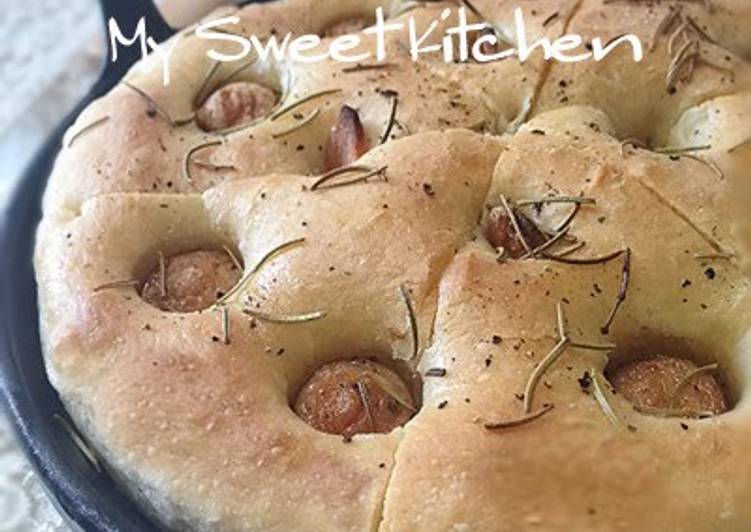
- Place your choice of ingredients into the holes. I used chorizo and garlic chips this time. Then I sprinkled it with rosemary and black pepper.
- I didn't add anything to the dough from Step 25. I only sprinkled it with rock salt and black pepper. I recommend using Krazy Salt or your favorite herbs.
- Bake the dough from Steps 30 and 31 in an oven at 190 - 200°C for 15-20 minutes. The photo in Step 31 is 230 g of dough.
- I baked the 315 g of dough in Step 30 at 200°C for 18 minutes.
- The chef said to bake it at 180°C but the strength of a professional oven vs. a household oven is somewhat different, so 190 - 200°C is fine.
- The surface will be crispy and the center will be fluffy. It is so delicious. And definitely professional-style!! The flavor of bread from the store is nothing compared to this.
- I baked this bread in a 20 cm Staub cast iron skillet which is 4 cm deep.
- I actually used garlic oil instead of olive oil for the bread with chorizo + garlic chip and rosemary + black pepper toppings.
- If you use garlic oil instead of olive oil, the garlic chips will go very well with the baked focaccia. I recommend doing this.
- This is the focaccia that I made the very first time when I didn't know a thing about baking homemade bread. This one was made with rosemary and olives.
- This is the cross-section. Even though this was the first time I ever bought dry yeast and the first time I ever hand kneaded dough, it came out fluffy and delicious.
The floral designs are inspired by Vincent van Gogh. Our focaccia has a moist but airy crumb sandwiched between thin but ultra-crunchy top and bottom crusts, thanks to a generous amount of olive oil. Focaccia is a classic italian flatbread. It can be kept plain with just a bit of olive oil and salt sprinkled over the top before baking, or it can be topped with My favorite is Focaccia al rosmarino which just means it has fresh rosemary sprinkled over the top. Some people also use this bread as the base for.
If you find this For Beginning Bakers: Maestro Focaccia recipe useful please share it to your friends or family, thank you and good luck.