Hey everyone, welcome to our recipe page, if you're looking for Hand Kneaded and Very Useful Standard Bread recipe, look no further! We provide you only the best Hand Kneaded and Very Useful Standard Bread recipe here. We also have wide variety of recipes to try.
Before you jump to Hand Kneaded and Very Useful Standard Bread recipe, you may want to read this short interesting healthy tips about {The Basics of Being Healthy. Becoming A Healthy Eater
When it comes to cooking healthy meals for our families, there is always some level of dissention among the ranks. The great news is that there are recipes which are extremely healthy but also the healthy nature of those recipes is somewhat disguised. What they don’t know in these instances truly should not bring damage their way (outside of allergies, which should never be discounted ).
Healthy cooking is often difficult because most of us do not want to spend time planning and preparing meals our households refuse to eat. At exactly the exact identical time, we want our families to become healthy so we feel compelled to learn new and enhanced methods of cooking healthy foods for our family to love (and unfortunately in some circumstances scorn).
With weight and nutrition known as the offender in so many health conditions it’s impossible to ignore the significance of not only eating healthy ourselves but also of educating our children the importance of eating healthy. One method to insure that your nearest and dearest are in fact eating healthy is to make sure you are cooking healthy and healthy foods for them. This doesn’t indicate you cannot enjoy the occasional calorie splurge or maybe that you shouldn’t. The trick to cooking healthy is always learning how to control portions and understanding the importance of moderation.
For those that are expecting to incorporate healthy cooking habits in their daily routines, there are no more resources available than ever before in order to assist you in those endeavors. It is possible to seek the services of a professional nutritionist, your health care provider can offer advice, it is possible to discover all sorts of publications on healthy eating, cooking, and living at your community library, and the Internet is an outstanding source of all sorts of information when it comes to leading a healthier lifestyle all over.
There are several books and magazines which are full of recipes that encourage healthy cooking and eating habits. If you really love to cookthen there’s absolutely not any shortage of recipes which you may try out along the way. The really great news is you may incorporate healthy cooking in your cooking routine whether you’re cooking for one or a family of ten.
There are many that can assert that cooking healthy food prices more than cooking the prepackaged foods that pack on the calories and additives. The truth of the matter is that if you compare the prices with all the health care bills of the long run for failing to accomplish this, they look quite slight by comparison. Yes, good food prices more money. Oftentimes, that is a very simple truth of life. But by learning portion control and eating the proper portions you may find that you’re actually spending less as you adjust to the proper quantities of food you should be consuming so as to keep a healthy and active way of life.
Cooking healthy is not an overnight change; it’s a lifestyle change which should be implemented one step at a time. You do not need to enter your kitchen and through out every tiny thing that you deem’unhealthy' simply work to never buy more of the items once they’ve been used. Make wiser decisions when purchasing fats for food preparation and you’ll find that you have created an incredibly important step in the process of integrating healthy cooking and eating habits within your house.
It is those tiny actions you take towards your objective of cooking healthy foods for your family that will matter far more than any leap. Before you know it you will find that you have greater energy and a better sense of overall health than you’d have envisioned before altering your cooking habits. If that is not enough to encourage you however, you may always have a look at the justification to go shopping for new clothes after you drop a size or 2.
We hope you got insight from reading it, now let’s go back to hand kneaded and very useful standard bread recipe. To cook hand kneaded and very useful standard bread you only need 10 ingredients and 29 steps. Here is how you achieve that.
The ingredients needed to prepare Hand Kneaded and Very Useful Standard Bread:
- You need 300 grams ●Bread flour
- Take 10 grams ●Skim milk powder
- Prepare 4 grams ●Salt
- Use 15 grams ☆Raw sugar (or caster sugar or light brown sugar)
- Prepare 40 grams ☆Egg
- Provide 170 grams ☆Water: Use lukewarm water during winter
- Use 5 grams ☆Dry yeast
- Prepare 20 grams ◎Butter
- Take 1 Egg or milk for eggwash/glaze: Use whichever depending on the type of bread you are making
- You need 1 Topping: Depends on the type of bread you are making
Steps to make Hand Kneaded and Very Useful Standard Bread:
- Place the ingredients marked with ☆ in a bowl and mix with a whisk.
- Place the ingredients marked with ● in a separate, large bowl and mix well with a dry whisk.
- Using either your hand or a rubber spatula, make a depression in the middle of Step 2, then pour the Step 1 ingredients into it.
- Combine the flour and the liquid by mixing from the middle and outward using either your hands or a rubber spatula.
- Turn out onto a working surface once the dough has more or less come together. Use a dough scraper to get all of the flour that is stuck on the sides of the bowl.
- The dough will still be quite sticky at this point, but that is okay. Knead the dough onto the surface, then combine again with a dough scraper; do this several times.
- If you repeat Step 6 several times, the dough will become easier to handle and will stick less to the surface.
- Grab an edge of the dough and slam it onto the surface.
- Once you slam the dough, fold it over, and…
- Hold an edge of the dough, rotate it 90 degrees so that it faces the same direction as in Step 8, and slam again. Repeat several times.
- When the dough is no longer sticky, fold it toward you, stretching out the surface of the dough, and…
- Push down with the heel of your palm. Repeat for about 10 minutes, occasionally using the motions from Steps 8~10.
- Once the dough has become glossy, cut a part of it with a dough scraper and stretch it out carefully. You will be able to see your fingers through the dough without it tearing if gluten has formed.
- Once the gluten has formed, spread the dough out. Place room-temperature butter in the middle, and wrap the dough around it.
- Combine the butter with the dough with a tearing motion. The dough will come apart, but it will come back together soon since gluten has been formed (Step 13).
- Repeat Steps 8~12 for about 10 more minutes until the surface is springy and shiny. Form into a ball by stretching the surface of the dough and pinching it at the bottom.
- Place the dough ball in a greased bowl and let it rise. If your oven has a proofing setting, then put it in there at 30℃ for about 45 minutes. You could also cover the bowl with plastic and leave it at a warm place.
- It has doubled in size. The time is just a guideline, so you should check the dough to see if it is done. Put some flour on your finger and poke a hole in the dough. If the dough does not spring back, then it is ready.
- Once the dough has risen, turn out onto a working surface and punch out the gas by pushing down the whole thing. You could put extra flour on it if it is sticky, but I almost never do.
- Divide into portions depending on your liking and the type of bread you are making.
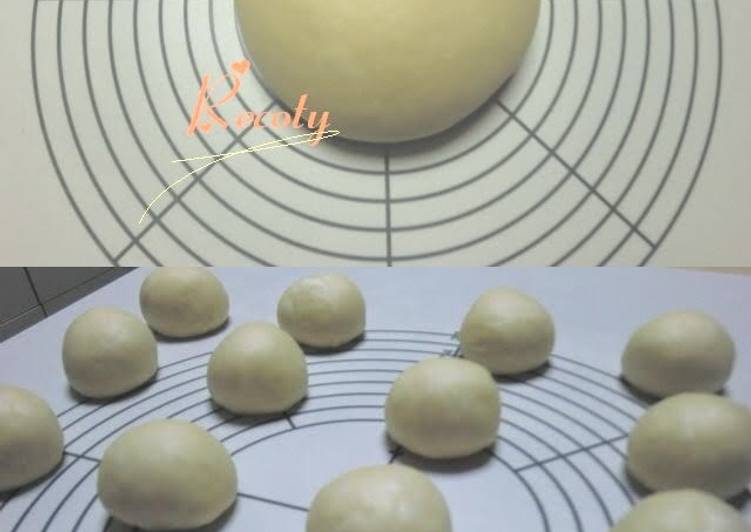
- Form the divided portions into a ball by folding it in on itself, then let them rest for 10~15 minutes. Leave them at room temperature, but cover with plastic wrap or damp cloth to keep them from drying.
- After resting the dough, shape them into the shape you like. Then let the dough rise again, in the same way as the first time for 35~45 minutes. It will become 1.5~2x the original size.
- Let the shaped dough rise on the baking sheet with which you will be baking. When they have risen…
- If you like, brush on the egg wash to add gloss and color to the bread. In which case, the egg left over from the dough making process should be more than enough.
- Bake in an oven oven that has been preheated to 200℃ for about 12 minutes. Please adjust oven temperature and baking time depending on your oven and the shape of your bread.
- The amount of liquid that is needed depends on the type of flour you use as well as the temperature and season. Until you get used to it, it would be good to leave out 1 tablespoonful of water in the beginning to see if you need it when you start kneading.
- I used the Haruyutaka brand and the Golden Yacht brand flours this time at a 1:1 ratio.
- Even if you are using a bread maker, wait until the gluten has formed before you add the butter. I really like to knead by hand.
- Little Anpan Made with Standard Bread - - https://cookpad.com/us/recipes/144812-mini-anpan-with-hand-kneaded-classic-bread-dough
Covered and left for ten minutes. I prepared and baked the bread machine and hand-kneaded pretzel dough batches the same way for the Every pretzel was edible and delicious. My family was very pleased with each batch and all the topping variations! A wide variety of hand kneading bread options are available to you, such as material, local service location, and key selling points. You can knead most bread doughs by hand or in a stand mixer (we'll show each technique in detail below).
If you find this Hand Kneaded and Very Useful Standard Bread recipe helpful please share it to your close friends or family, thank you and good luck.