Hey everyone, welcome to our recipe site, looking for the perfect Homemade Tonkotsu Ramen Broth and Noodles from Scratch recipe? look no further! We provide you only the perfect Homemade Tonkotsu Ramen Broth and Noodles from Scratch recipe here. We also have wide variety of recipes to try.
Before you jump to Homemade Tonkotsu Ramen Broth and Noodles from Scratch recipe, you may want to read this short interesting healthy tips about {Easy Ways to Get Healthy. Becoming A Healthy Eater
The majority of us have a fairly good idea about what healthy eating is: plenty of fruits and vegetables and not too much fat and sugar. But when it comes to children, knowing what is healthy is simply the start. And even in the event you keep’healthy' it doesn’t necessarily mean that your child will eat it.
There’s hope. Children need some extra encouragement and guidance along with a few of the strategies your kid is guaranteed to eat healthy.
Make a gatekeeper.
It is very likely that the simplest way to get your kids to eat healthy is to remove the less-healthy choices. Take control over what food and snack choices are in your dwelling. If a kid is hungry they’ll eat it whenever there isn’t another alternative. Perhaps you have heard of a kid starving to death since his parents would not feed him potato chips?
Maintain healthy food in sight.
As for those less-than-good-for-you foods, maintain them in high cabinets and from your child’s reach. Arrange your refrigerator and cabinets to ensure healthy foods are the primary foods that you see. If you choose to have some unhealthy options in the house keep them from sight and also you and your children are going to be much less inclined to choose them as an option.
Make healthy food convenient.
Wholesome foods, particularly fruits and vegetables require little preparation that’s great for your’starving' child and you. You might be surprised at how a lot more fruits and vegetables that your kid will eat simply by using them visible and easy to grab.
Make learning about meals enjoyable.
Prepare family foods together, have your kid mix the ingredients and serve the meals to the rest of the family. Plant a vegetable garden for a family job and place your kid responsible for watering and picking the ripe vegetables. Kids who are involved are far more inclined to be a willing player in the ingestion procedure.
Keep Your Eye on Portion sizes.
Parents often stress over how much their children should be eating. Whether you are attempting to find a selective eater to have a bite of anything green or limit the quantity of dessert that your sweet-toothed kid wants watching portions is essential. Knowing the size of a healthy portion will give you some fundamental perspective.
Set a healthy example.
Remember that eating foods together is not just a wonderful way to grab on your household day it’s also the perfect time to role-model healthy eating habits. Kids learn by watching their parents…That’s food for thought!
We hope you got benefit from reading it, now let’s go back to homemade tonkotsu ramen broth and noodles from scratch recipe. You can have homemade tonkotsu ramen broth and noodles from scratch using 19 ingredients and 25 steps. Here is how you do it.
The ingredients needed to prepare Homemade Tonkotsu Ramen Broth and Noodles from Scratch:
- Take Soup
- You need 5 bones Pork on the bone
- You need 2 Japanese leek
- You need 2 medium Onions
- Provide 1 tsp Grated ginger (tube is fine)
- Provide 1 tsp Grated garlic (tube is fine)
- Provide 100 grams Pork fatback
- Take 1 enough to fill a large pot Water
- You need Noodles
- Use 500 grams All-purpose (medium) flour
- You need 1 -5 1/2 grams Powdered kansui (alkaline minerals)
- Get 200 ml Water
- Use 1 for dusting Katakuriko
- You need Char siu (Chinese-style roasted pork)
- Provide 500 grams Thinly sliced pork belly
- Use 50 ml Soy sauce
- You need 50 ml Mirin
- Get 1 tbsp Sugar
- Get 500 ml Water
Steps to make Homemade Tonkotsu Ramen Broth and Noodles from Scratch:
- I got these pork bones at the supermarket (they were being sold for about 15-30 yen per 100 g in my neighborhood). I think about 5 bones come out to 3 kg.
- Wash off the blood under running water. Place the bones in a large pot of cold water. Bring the pot to a boil (at this point, the bones will be giving off a very strong odor, but don't worry).
- A lot of scum will come to the surface. Scoop it out diligently (I know this part is a bit off-putting, but stick with it. It'll turn out okay).
- Strain in a colander and remove the remaining blood from the bones with a scrubbing brush.
- Use a saw to make a slice in middle of the bones, and a hammer to break them in half. (It's easier if you make an incision before snapping them).
- Look at all the bone marrow inside the bones. We'll be melting it out by simmering these bones over a long period of time.
- Now start to add the other ingredients for the soup. Diligently remove the scum that rises to the top. Keep the heat at medium and maintain a gentle boil.
- Once the scum has been removed, simmer the broth for another 6 hours. Add more water if it boils off.
- Next we'll be preparing the noodles. Measure out the ingredients and mix the flour and powdered kansui together. Add the water. It'll feel like a very small amount of water, but don't worry.
- Mix the ingredients until the dough starts to clump together in the bowl.
- The dough is a pretty tough one, so be careful not to hurt your wrists. Try mixing it with the weight of your body.
- Move the dough to a working surface and knead. Don't worry too much about cracks or inconsistencies yet. Just knead for about 10 minutes.
- Round up into a ball, wrap with plastic cling wrap, and let sit in the refrigerator (for at least 30 minutes. Then check if the dough has settled).
- Prepare the char siu in the meantime. Brown the meat in a frying pan, and simmer for 2 hours in a pot with the combined seasoning ingredients. Let cool in the pot.
- Once the dough has become moist, roll out to a thickness of 5 mm. Use a pasta machine to even it out to your desired thickness.
- If you don't have a pasta machine, just use a rolling pin to stretch out the dough (but remember that the dough will thicken up about 1.3 times, so include that in your calculations).
- You can manage with just a little bit of dusting flour (katakuriko or bread flour) since the dough isn't that sticky.
- Apparently a wooden box is best for storing Chinese noodles, but if you don't have one on hand, just transfer them to a tray lined with parchment paper. Insert tray in a plastic bag and keep cool in the refrigerator.
- About two hours after simmering the broth, it'll start to get white and cloudy. I wouldn't taste testing it just yet, since it'll still be somewhat smelly.
- Here's what the broth should look like after 6 hours of simmering. The marrow has melted out of the bones, which have emptied out. The soup now looks quite rich and smells like it should (just like what you get a ramen joint).
- The char siu should have become a caramel brown. Take care not to break it apart when you're slicing the meat, since it'll be quite soft at this point.
- Enjoy the leftovers with a cold beer!
- Now that you have everything prepared, get ready to make your ramen. Boil each serving of noodles separately and adjust the times carefully by watching over them. If you'd like your noodles rippled, squeeze the noodles once and fluff them out again before boiling.
- Warm up the bowl you'll be using for the ramen. Add the simmering sauce you used for the char siu and season with some salt (starting on the lighter side so the taste is easier to adjust) and pour in the pork broth you prepared earlier.
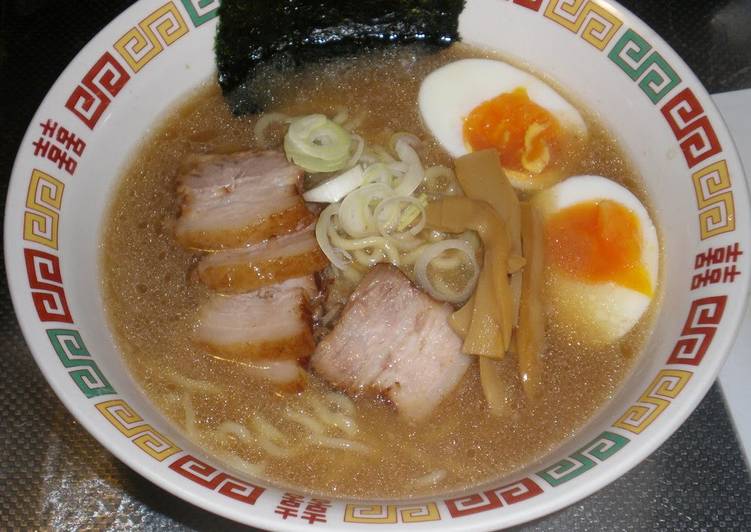
- The boiling time for the noodles should be about 1:30-2 minutes, but this is something you can change according to your preferences. Once you add your noodles to the soup and garnish with your desired toppings, your rich and creamy tonkotsu ramen is complete.
If you find this Homemade Tonkotsu Ramen Broth and Noodles from Scratch recipe valuable please share it to your close friends or family, thank you and good luck.